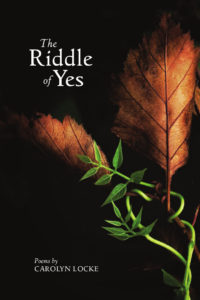
In this poetry collection, Carolyn Locke has taken a leap of faith, following startling images and mysterious voices into the territory of beauty and loss, where all is not as it seems. Sometimes quiet and meditative, sometimes unsettling and surreal, these poems offer an unflinching look at the cycle of life and more than enough reasons to celebrate it.
Praise for The Riddle of Yes:
In The Riddle of Yes, Carolyn Locke’s luminous, meditative poems guide us on the one journey we all take. We experience the deaths of others and sense the steely presence of our own. Like the dying friend in “Lament,” we ask “How long?”; we feel the heartache and confusion of being “between.” Time, that errant one, suspends itself; and we wayfarers, enclosed in its otherworldly shadow, walk the path of riddles, dreams, and the sudden shapeshifting of skins—“It starts when she looks in the mirror / and isn’t there.” Then comes a “blessed stillness,” a letting go of certainties: lines dissolve, skin melts, mouths morph into cathedral windows. We become echoes of “every where” and “every time.” We empty and fill; we dissolve into nothing and everything; we are rose, seed, wind. We are the AND, the “YES.” In these poems that pay loving attention to both life’s wonders and death’s necessary embrace, the momentary and the forever meld…
—Margaret Yocom, author of ALL KINDS OF FUR: Erasure Poems & New Translation of a Tale from the Brothers Grimm
Carolyn Locke’s poems possess lyric qualities and move like a film of words. Her lines have the power to coalesce and expand from scene to scene, as when she writes, “so many unanswered questions / unwinding through the universe.” In some of her poems, when she comes closest to loss, she eschews punctuation and uses the lower case, including the diminished I, as in, “i tell you i believe in death.” Such quiet force can be likened to a nebula where her poems dwell suspended in time, steeped in the primordial seas of riddles to find the Yes. In their breadth, Locke’s poems are universal and nuanced, and in their natural music they embrace life wholeheartedly.
—Joseph Zaccardi, poet laureate of Marin County, California (2013-2015) and author of A Wolf Stands Alone in Water, The Nine Gradations of Light, Render, and Vents.
The poems in The Riddle of Yes by Carolyn Locke are not observations, thoughts or reflections, they’re direct experience. The experience is not just that of the poet, but also belongs to the reader who, sitting still with book in hands, forgets that the chair and the lamp are even there because “what you will find is a cove/emptying and filling without end.”
Locke’s poetry has long been bringing together the concrete and the imagined, the physical world and the world of spirit. Inthis collectionher poems achieve mastery, a seamless shape-shifting of consciousness, another dimension of placewhere the fox, the great maple and the woman who “wakes with a bird in her belly”all exist in the same tangible realm with equal impact. This is magnificent work.
—Barbaria Maria, author ofCrossing Time and Palace Boulevard